
My work is rooted in a simple understanding: human beings are not static.
We are always changing. Our bodies change. Our emotions change. The way we meet life, ourselves and others is always moving. Even when we feel stuck, something in us is still responding, adapting, protecting, or trying to heal.
This understanding lies at the heart of the Pantarei Approach, a body based approach that deeply shaped the way I work and the way I understand healing. The name Pantarei reflects the idea that everything flows. For me, this is not only a concept. It became a guiding philosophy for how I relate to myself, to challenges, and to the people I work with.
Over time, this approach became more than a method. It became part of how I see life. My work today grows from this foundation, while also being shaped by my own experiences, my curiosity, and the many tools that now support the people I work with.
At the core of it all is a simple trust: human beings are living processes. Healing does not come from forcing ourselves into fixed ideas of who we should be. It often begins when we can listen more honestly, feel more clearly, and come back into relationship with ourselves.
Healing is often not about forcing change. It is about creating the conditions where movement can naturally return.
We are living processes
Human beings cannot be reduced to diagnoses, problems, or fixed identities. We are living processes.
There are times when we feel overwhelmed, disconnected, emotionally confused, or physically stuck. Anxiety, tension, pain, numbness, or inner pressure can make it seem as if nothing is moving. Yet even then, something within us is still alive. Something is still trying to respond.
For me, healing is often not about forcing change. It is about creating the conditions in which movement can return naturally. Sometimes that movement is physical. Sometimes it is emotional. Sometimes it is a shift in perception, a sense of relief, a deep breath, a moment of clarity, or a new way of meeting what is here.
Healing is not always linear. Sometimes the process is quiet, slow, or even confusing. But that does not mean nothing is happening. Often it means something deeper is reorganizing.
The body can be the doorway
I do not see the body as something that has failed.
I see it as a source of information, intelligence, and lived experience.
The body carries our history. It reflects how we learned to cope, protect ourselves, adapt, and navigate the world. Physical tension, emotional overwhelm, chronic discomfort, numbness, and pain often hold meaningful information about what we have lived through.
Instead of trying to simply eliminate symptoms, I am interested in understanding what the body might be expressing. Often the body is not the obstacle. It is the doorway.
What this means in practice
This does not mean suffering should be romanticized. Relief matters. Support matters. But in my experience, healing becomes deeper and more lasting when we do not only try to silence symptoms, but begin to understand the intelligence beneath them.
I do not approach people as problems to solve. I try to listen for what the body may already be communicating through tension, numbness, pain, overwhelm, withdrawal, or holding.
Change often begins through experience
Change does not always happen through thinking alone. Often it happens through experience.
In my sessions, touch, breath, awareness, and conversation become part of a shared process of exploration. I work slowly and attentively, listening not only to words but also to what the body expresses.
Good work for me is not about applying a fixed technique. It is about creating a space where a person can reconnect with themselves in an honest and supportive way. When that happens, something often begins to soften. Something begins to move.
How this can feel
A person may arrive feeling tense, disconnected, or unsure what they even need. And then, through contact, attention, and a little more safety, they begin to notice their breath again, feel their body more clearly, or sense an emotion that was hidden beneath the tension.
Often this is where real change begins. Not in a dramatic breakthrough, but in a more honest contact with what is already there.
There is no single right way to heal
A central part of my philosophy is that each person is unique.
There is no single right way to heal or to live. Healing looks different for each person because each person carries a different story, different strengths, different wounds, and a different way of being in the world.
Many people have learned to disconnect from parts of themselves in order to function, belong, or meet expectations. Over time, this can create distance from who they truly are.
Healing often includes reconnecting with the qualities that were pushed aside. Sensitivity. Creativity. Boundaries. Vulnerability. Strength. Truthfulness. Aliveness.
A deeply personal part of this philosophy
This insight is deeply personal for me. At some point I realized that my own sensitivity was not something to overcome. It was part of my strength and part of the path that brought me to this work.
I believe there is beauty in the uniqueness of every person and in the diversity of life in all its expressions and colors. To me, healing is not about becoming more acceptable, more polished, or more the same. It is about becoming more whole.
Learning through the body
For a long time, Somatic Learning was the clearest name for the heart of my work.
It still describes something essential: that real change does not happen only through insight, analysis, or symptom relief. It also happens through learning by way of the body. Learning to feel yourself more clearly. Learning to sense your needs, your boundaries, your patterns, your reactions, and your inner resources. Learning to trust what is real in you.
Somatic Learning remains the foundation of my work. The body is not separate from healing. It is one of the main ways healing becomes possible.
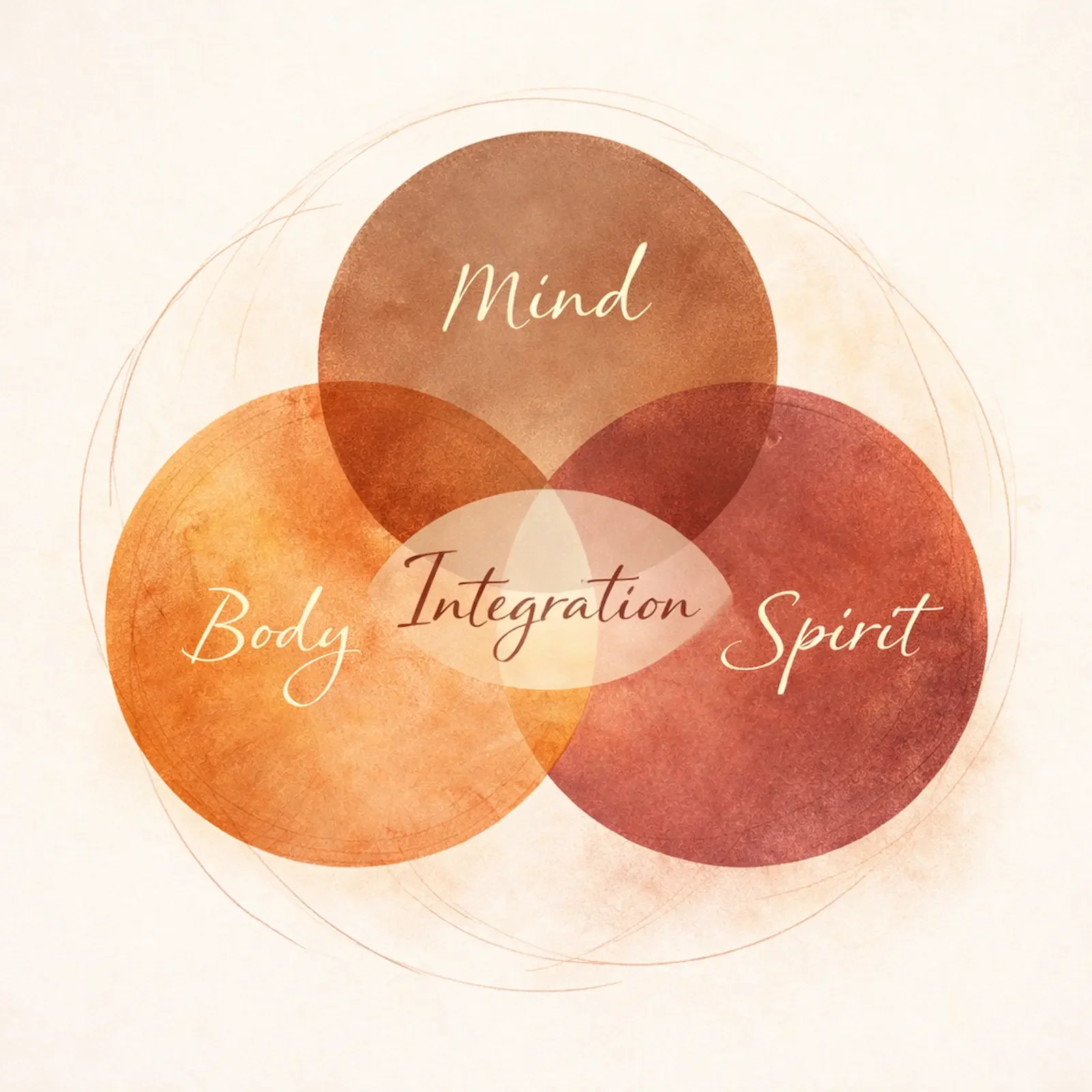
This is why touch, awareness, nervous system regulation, emotional integration, movement, breath, and honest dialogue all belong together in my approach. They help people come back into contact with themselves in a way that is not only understood mentally, but actually felt and lived.
Following the work further
Over the years, I saw again and again that this work naturally extends beyond physical, mental, and emotional well being alone.
When people feel safer in their bodies, more regulated in their nervous systems, and more deeply connected to themselves, something else can begin to happen. Perception can shift. People may experience unusual clarity, deep stillness, emotional insight, a stronger sense of connection, or a wider experience of self and life.
For some, this may feel like a deep return to themselves. For others, it may feel like the mind becomes quieter, the body more open, or awareness more spacious. I do not see these states as something separate from embodied healing. I see them as a natural extension of it.
An important realization
At some point, I noticed that the work was no longer only about relieving pain, reducing stress, or processing emotion, even though all of that still matters. It was also opening into a wider field of self exploration, perception, and human potential.
This expansion did not feel like leaving Somatic Learning behind. It felt like following it further.
A wider ecosystem growing from the same root
This is where the name Satori Institute began to make sense.
For me, the Satori Institute is not a break from Somatic Learning. It is what grew from it.
Somatic Learning names the body based root. The Satori Institute names the wider ecosystem that unfolded from that root.
It holds the same values and the same trust in the intelligence of the body, while making room for the broader field my work has grown into: somatic therapy, holistic bodywork, trauma integration, nervous system regulation, psychedelic integration, fasting, workshops, and expanded state experiences that remain grounded in embodiment, safety, and real life integration.
Why the name resonated
The name Satori resonated with me because it points toward moments of realization, awakening, and deeper clarity. Not as something dramatic or inflated, but as something I have witnessed again and again in this work.
Sometimes a person does not need more force. Sometimes they need the right conditions for something to open. A moment of truth. A felt shift. A deeper coherence. A clearer sense of who they are.
That is what the Satori Institute represents for me. Not leaving the body behind and moving into something abstract, but staying rooted in embodied work while opening space for heightened perception, expanded awareness, and deeper states of integration.
So this transition is not a rebrand in the shallow sense. It is the natural evolution of the philosophy itself.
Wholeness includes belonging
This philosophy is not only about healing in the abstract. It also shapes how I relate to difference, identity, and belonging.
If healing means becoming more whole, then it also means having the freedom to exist more fully as who you are.
I want my work to be a space where people do not have to hide parts of themselves in order to feel welcome. Safety matters. Consent matters. Dignity matters. Personal freedom matters. Being met as you are matters.
Part of the beauty of life
This includes people of different backgrounds, identities, expressions, and life experiences. Diversity is not something outside the philosophy. It is part of the beauty of life itself.
To honor the uniqueness of a person also means respecting the realities they live with and the ways they move through the world.
A clear foundation, a way of working that became my own
The Pantarei Approach forms an important foundation of my work. Its emphasis on flow, presence, embodiment, and individuality influenced me deeply.
At the same time, my work has grown through years of practice, learning, and lived experience.
I integrate different perspectives that support people in reconnecting with themselves in meaningful ways. These include trauma sensitive bodywork, work with chronic pain, movement, breath, nervous system regulation, and approaches that support expanded and non ordinary states in a grounded and careful way.
I try to see the whole person.
Your body, your emotions, your history, your patterns, your resources, your sensitivity, your identity, your way of making meaning, all of it matters.
So while the roots are clear, the way I work has become uniquely my own.
You do not need someone to fix you
I do not believe people need someone to fix them.
My role is to meet you with presence, skill, and curiosity while supporting your own process of discovery. You carry your own resources and your own wisdom, even if they are not always easy to access.
This does not mean everything has to be done alone. Healing happens in relationship. It can be deeply supportive to have a space where you are met, reflected, accompanied, and gently challenged when needed.
In this work, relationship matters. Safety matters. Pace matters. And being met as a whole person matters.
A philosophy of trust, curiosity and expansion
At the heart of my work is a simple trust.
I trust that the body carries intelligence.
I trust that what has been shut down can be met again with the right support.
I trust that symptoms are often part of a deeper process.
I trust that healing is not about becoming someone else, but about coming into a more honest relationship with who you already are.
And I trust that when we meet ourselves with honesty, curiosity, and care, change becomes possible in ways that are deeply embodied and real.
What this means more clearly
What is the philosophy behind your work?
My work is rooted in the understanding that human beings are living processes, not fixed problems to solve. Healing often begins when we can feel more clearly, restore safety, and come back into relationship with ourselves through the body.
What does Somatic Learning mean in your work?
Somatic Learning describes the body based foundation of my work. It means learning through the body, through touch, awareness, nervous system regulation, breath, movement, emotional integration, and honest dialogue.
Why did the work expand into the Satori Institute?
Over time I saw that this work naturally extends beyond symptom relief into deeper states of clarity, connection, expanded awareness, and integration. The Satori Institute grew from the same somatic foundation while making room for a wider field of work.
Is the Satori Institute separate from Somatic Learning?
No. Somatic Learning names the body based root of the work. The Satori Institute names the wider ecosystem that grew from that root, including somatic therapy, bodywork, trauma integration, nervous system regulation, expanded state experiences, and related processes.
How does inclusion relate to your philosophy?
Inclusion is part of the philosophy itself. If healing means becoming more whole, then it also means having the freedom to exist more fully as who you are. Safety, consent, dignity, and being met as a whole person matter deeply in this work.
If something in these words resonates with you, you are welcome to explore this work with me
Healing, for me, does not only mean feeling better. It can also mean becoming more whole, more connected, more awake, and more able to live in relationship with yourself, others, and life.
This is the philosophy that guides my work.
Somatic Learning • Satori Institute • Straßmannstraße 3, 10249 Berlin Friedrichshain • English & German